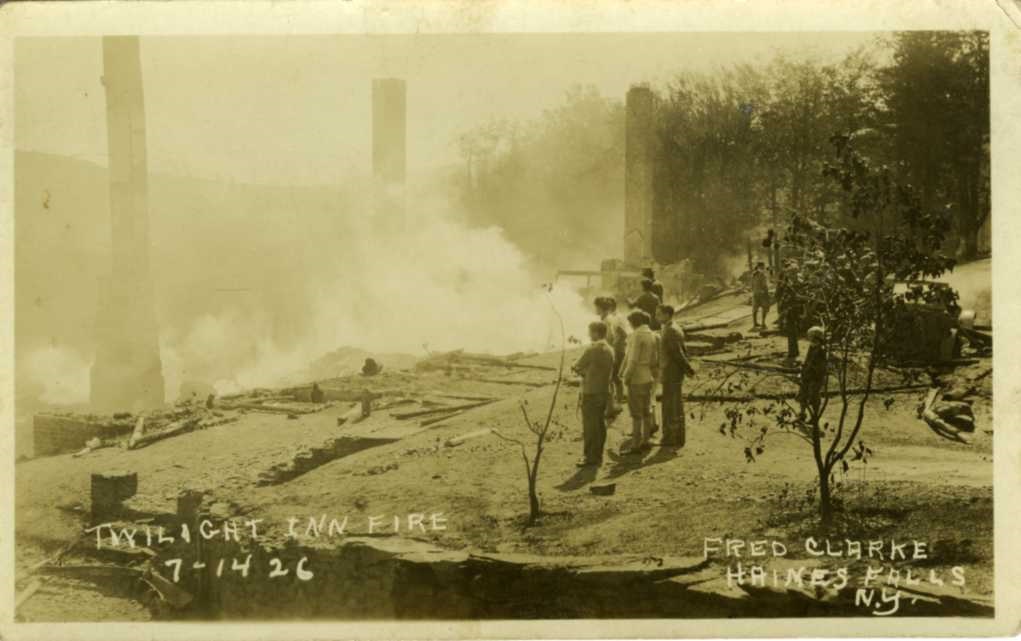
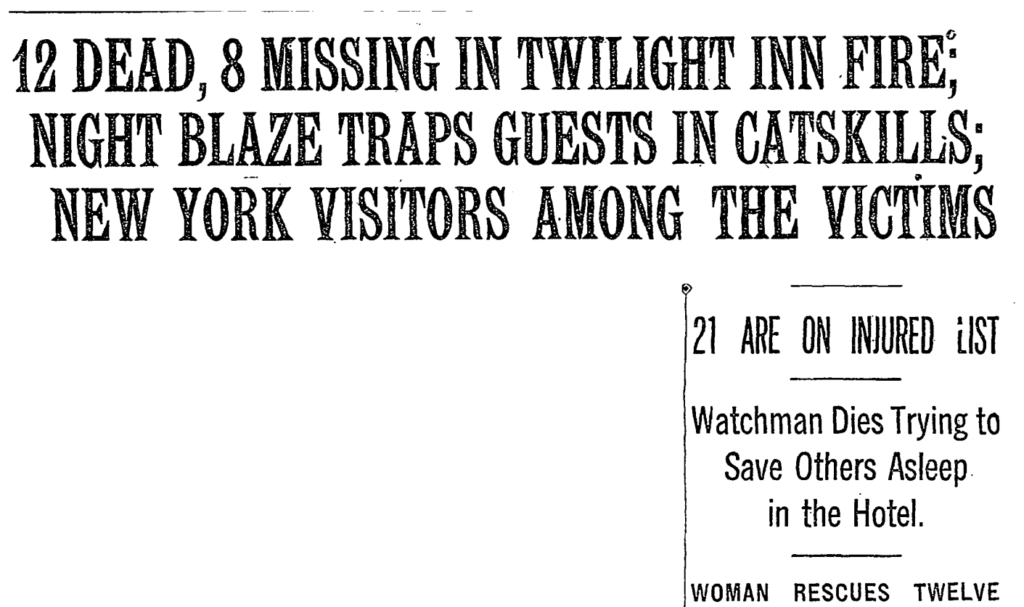
Thank you for the outstanding turnout to our “If These Stones Could Talk” Cemetery Tour last Saturday morning! More than 40 people joined Joanne Ainsworth and Dede Terns-Thorpe to explore the histories behind the gravestones in the Haines Falls Cemetery and the Haines Family Cemetery. One of the stops along the tour was a large stone memorial to those who lost their lives in the Twilight Inn Fire in Haines Falls, which occurred the evening of July 14, 1926. I’ve shared here some images taken during the aftermath of the tragedy that claimed at least 19 lives and detailed some of the tidbits from the events of the fire as reported by the New York Times below. The images are from the MTHS Archives. The last photo shows the memorial to the victims of the fire at the Haines Falls Cemetery.
During the cemetery tour, we listened to the story of how Susan Tressler’s grandmother’s body was exhumed in the Haines Falls Cemetery for reasons that are still not entirely clear. You can revisit the story or listen to it for the first time on our Soundcloud at: http://tinyurl.com/2p98s9fe You can also listen to an oral history interview conducted with a survivor of the fire conducted by Justine Hommel in 1982 at: http://tinyurl.com/mr3s4uw5
Cemetery Tour & Twilight Inn Fire

The Twilight Inn Fire
July 14, 1926
The fire began just before one in the morning in the male workers’ quarters after most guests and employees had gone to sleep for the night. Carl Stryker, the night watchman, worked to alert everyone in the building of the fire’s threat and guide them safely outside. Stryker entered the building six times to locate and recover folks. Tragically, the last time he entered the building the floor collapsed, and Stryker’s life was taken.
Tannersville residents Harold and Leon Terns were the first locals to arrive on the scene of the fire. They went in and out of the burning building three times to rescue people. Miss Hannah Hyatt, a guest, led twelve other guests to safety through a trapdoor. She suffered two broken ribs in the process. One mother was forced to throw her six-year-old child out a second story window to a man standing below. She managed to jump out of the window after him. Another guest reentered the building to find her husband, not knowing that he had already managed to make it safely outside. She died in the effort.


Despite later reports of the inn’s lack of fire safety infrastructure, the Inn was properly equipped with fire extinguishers and guide ropes, as well as a wooden fire escape. Despite these safety implements, which were in line with the code for the time, many were not able to find their way out through the smoke and flames as it rapidly consumer the wooden Inn.
Reports said that the blaze developed so rapidly that it could be seen for miles. By the time the local fire companies arrived, the fire had so fully engulfed the building that the opportunity to stop its path had passed. Screams were reportedly heard on the upper floors where guests remained trapped. Once the water from the firetruck was exhausted, water was pumped out of the creek to help extinguish the flames and an evening rain helped the process along.
The number of wounded people overwhelmed the nurse and available beds at the Red Cross Hospital in nearby Tannersville. Locals were rallied to provide additional cots and care for the wounded.


The New York Times reported that the bodies recovered from the inn were so badly burned they were beyond identification. One means that was developed to identify the dead was to monitor what mail remained uncollected in the days following the fire.
A monument dedicated to the victims of the fire was erected in the nearby Haines Falls Cemetery behind the Methodist Church. Interestingly, the year of the fire is listed as 1925 not 1926.


The monument reads:
“In memory of those who lost their lives in Twilight Inn Fire July 14, 1925
Herbert E. Beardsley
His Mother
Henrietta L. Beardsley
Charlotte Brinton
Herman Engle
His Wife
Adelaide S. Engle
Mary Erdelin
Julia H. Hennesey
Anne E. Milbank
Ernest Poetzsch
Isabel Chapman Brooks
Florence Chapman Monroe
Little Billy Deyarmon
Carl Stryker
Kate E. Thomas”
Post by Alexandra Prince


